
Bamboo
-By Michael Poon
-SBI3U
Root System and Rhizomes
-Roots: The roots of bamboos is a adventitious root which is a root that develops from somewhere other than the root apical meristem that emerges from seed. On the other hand, the main function of the root are anchor the culm to the ground. It is to make sure the plants will not be at vulnerable to damage from severe weather. This also allows the bamboo to hold more weight in order to give ability to grow more leaves over wider distances. The root can also stores nutrient but this is not it's main function and most of the nutrients are stores in the rhizomes.
-Rhizomes : horizontal, underground plant stem capable of producing the shoot and rootsystems of a new plant. This capability allows the parent plant to propagate vegetatively (asexually) and also enables a plant to perennate. Also they collect and store the primary nutrient for growth. The functions of rhizomes is the reason that bamboo have such a massive growing speed.
Bamboo rhizomes grow in two unique characteristics. They either grow in a clumping formation or they can grow in a running habit. The rhizome growth patterns classify bamboo either as a clumping bamboo or a running bamboo.


Leaf Systems
Leaves are present at every main portion of the bamboo plant, which includes the rhizomes, culm, and branches. The leaf itself serve as a blade, sheath, and ligule.
-A Sheath
Each internode of the bamboo are covered by a tubular sheath which attached to the node and ends in a blade. The tubular sheath are technically leaves. The leaves serve as a protective cover to encase the rhizome as it travels underground.
-A Blade
Blades are part of the culm sheath and leaf sheath and it locate beyond the ligule.The blade provides the photosynthetic function of the plant by converting sunlight into energy. The appearance of the blade varies among species.
-A Ligule
At the apex of each culm sheath or leaf sheath, where the blade is attached, a thin membrane is found extending upwards along the apical margin, pressed against the underlying culm internode, culm sheath or foliage leaf. This ligule, literally a little tongue, varies in height, lateral breadth, hairiness, edge shape in terms of serration, and edge ciliation, and these characteristics are very important to distinguish species.
Culm {Stem}
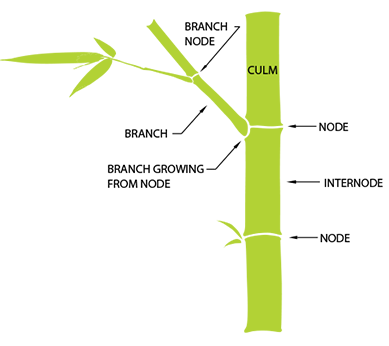
The stem of Bamboo is call culm. The culms are hollow but some species of bamboo have solid culms. Each culm segment begins and ends with a solid joint called a node. Nodes are are characterized by a swelling encircling the ends of the culm segments. The segments between the nodes are called internodes. From the nodes grow leaves and branches. Similar to the culms, the branches are also segmented with nodes and internodes.

-{Clumping Bamboo}
Clumping bamboos have Pachymorph rhizomes that grow upwards and developinto a new culm. New rhizomes emerge from buds on an existing rhizome and so forth. This causes the grove to expand slowly around the perimeter. This growth behaviour gives the bamboo a 'clumping' habit.
-{Running Bamboo}
Running bamboos have Leptomorph rhizomes that run horizontally under the ground. New buds and roots come out from the nodes of the rhizomes and most buds remain dormant but may either develop into a new culm or into another new rhizome. The new rhizomes will also run horizontally underground and produce more news culms and rhizomes as the other rhizomes. This growth behavior gives the bamboo a 'running' habit.


Flowering of Bamboo
Unlike the majority of plants and trees you may be familiar with, most bamboo species seldom flower. It should be noted that some species of bamboo do flower annually, although this is not the norm. Bamboo exhibits what is known as gregarious flowering, or mass flowering. All plants in a grove will flower simultaneously, regardless of outside conditions that may be present. Climate and geographical location has an impact on the timing at which bamboo flowers. This mass flowering is likely connected with vegetative propagation, the way in which bamboo spreads both in the wild and in human cultivation. Propagation is typically conducted by splitting the rhizome of the plant and transplanting into a new location.

